← Blog
How Much Does AI Development Cost in 2026? Ranges by Project Type
Summary
- A focused first version of most AI projects takes about 300–950 hours: roughly 11,000–37,500 at 40 per hour.
- Chatbots and RAG assistants sit at the lower end; custom ML and computer vision from raw data at the upper end.
- Most hours go into data, search, interface and testing, not the model; budgets that leave out testing and management overrun.
- Unready data, integrations, extra platforms and speed raise the cost; one use case with a clear success metric keeps it small.
Ask an agency what an AI project costs and the honest first answer is “it depends”. That is true, but it is not useful when you need a number for next year’s budget or a board slide. This guide gives real ranges for the six kinds of AI project we are asked about most, explains where the hours go, and lists the decisions that move the price the most.
The ranges below come from the same hour-by-hour catalogue our online estimator uses, for a senior team that has built each kind of system before, at 40 per hour in euros or dollars. Use them as a sense of scale. A written quote still needs a conversation about your data, your systems and what “working” means for you.
Typical ranges by project type
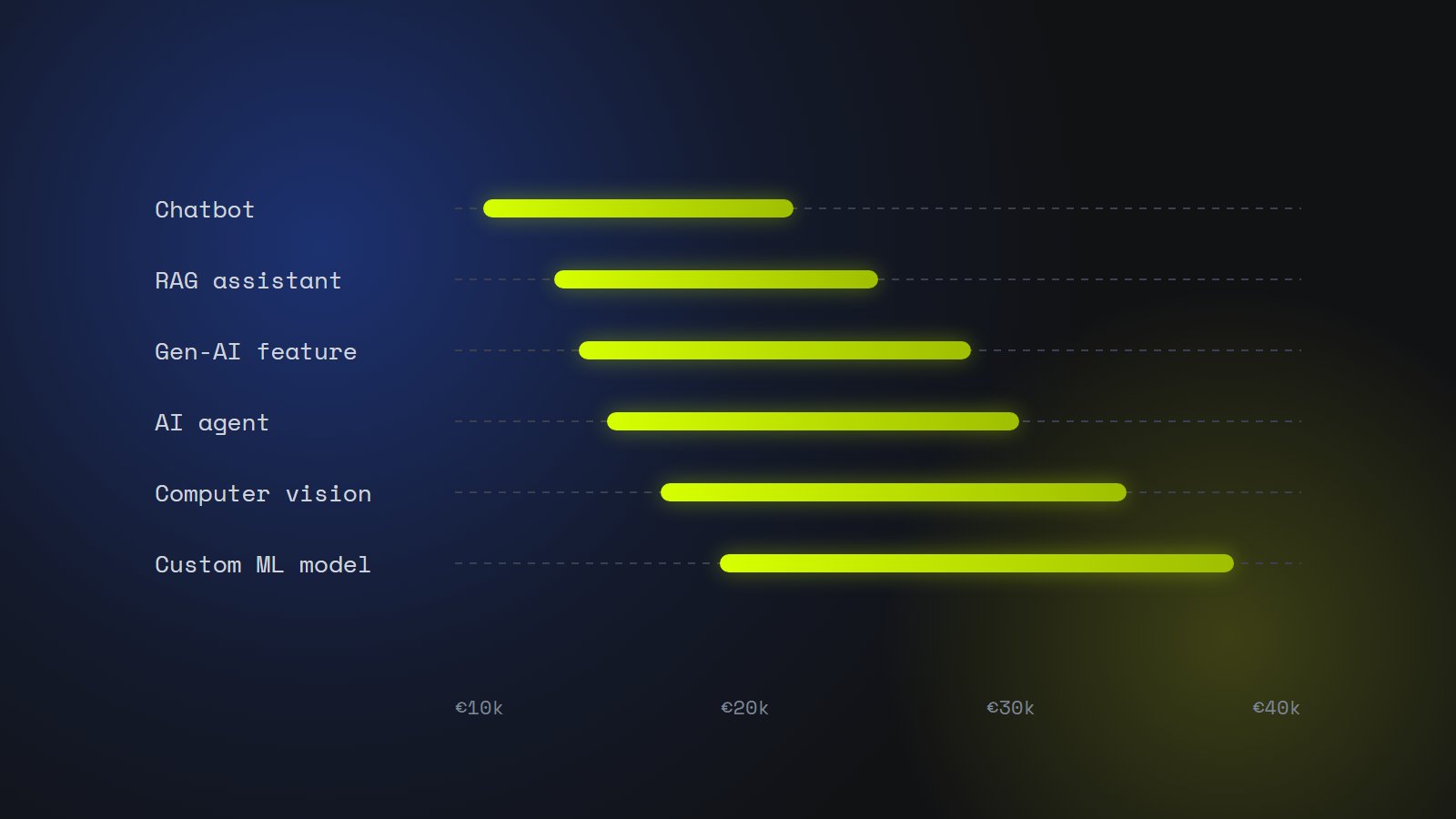
Customer chatbot (web widget plus WhatsApp or Telegram, answering from a knowledge base, with hand-off to a person): about 290–550 hours, 3–6 weeks, roughly 11,000–22,000.
RAG assistant that answers questions from your documents with source citations: about 340–620 hours, 4–7 weeks, roughly 13,500–25,000. Add per-document permissions and connectors to Confluence, SharePoint or Google Drive and it becomes 410–780 hours, roughly 16,500–31,000.
Generative AI feature inside an existing product (for example drafting, summarising or extracting data, with an evaluation set and guardrails): about 360–710 hours, 4–8 weeks, roughly 14,500–28,500.
AI agent that automates a business workflow across your systems, with human approval steps and an audit log: about 390–750 hours, 4–8 weeks, roughly 15,500–30,000.
Computer vision (detection, segmentation or classification) starting from unlabelled images: about 430–850 hours, 5–9 weeks, roughly 17,000–34,000.
Custom machine learning model (forecasting, scoring, recommendations) starting from raw data: about 490–940 hours, 5–10 weeks, roughly 19,500–37,500.
Each figure is for a first production version with user accounts, a simple interface, testing, project management and deployment included. A proof of concept that only needs to convince your team costs noticeably less; a product for thousands of external users costs more.
Where the hours actually go
Buyers often expect the model to be the expensive part. It rarely is. In a typical RAG or chatbot project, calling a language model is a small share of the work; most of the hours go into getting documents in and keeping them in sync, making search find the right passage, building an interface people will use, and testing answers against real questions.
Across projects the split is roughly: discovery and scoping 8%, design 12%, development 55%, testing 15% and launch 10%. Quality assurance adds 10–28% on top of the build, depending on how costly mistakes are, and project management about 12%. Budgets that leave these out are the ones that overrun.
What makes the budget grow
Data that is not ready. For machine learning and computer vision, cleaning and labelling raw data adds 40–80 hours; having no data yet and needing a collection plan and a first labelled set adds 60–120. This is the most common reason AI projects slip.
Integration with existing systems. Connecting to a CRM or ERP adds 32–64 hours, and fitting the AI into a product that is already in production adds another 32–64 for the work around it.
More platforms and a premium finish. A native mobile client adds 60–120 hours per platform, and a custom-designed interface adds a real design phase of 40–80 hours rather than just nicer styling.
Speed. Adding a person to finish sooner costs more per week of work; in our estimates, a fast-track plan adds about 15% to the cost.
What keeps it small
Start with one use case, one team and one data source, and agree a success metric before any code is written — for example “answers 80% of support questions about returns correctly, with a source”. A narrow first version is cheaper, ships sooner and tells you whether the bigger plan is worth it.
Use existing models before training your own. For most document and language tasks, a well-built RAG system on a hosted or open model beats fine-tuning on cost and accuracy. Keep fine-tuning or custom training for problems that need it.
Choose a partner who shows a working prototype on your data within weeks and bills by milestone, so you pay for progress you can see.
Running costs after launch
Plan for two ongoing costs. The first is usage: language model and cloud fees grow with the number of questions or images processed, so we track cost per request from the first day. The second is maintenance: keeping integrations working, updating documents and models, and reviewing answers that users flag. A small monthly support budget is usually enough for a focused assistant.
Get a range for your own project
Our free estimator at mlmind.io/estimate asks about your project type, data, platforms and priorities, proposes a feature list and shows hours, weeks, team and cost — adjustable to your own hourly rate. If the range fits, a 30-minute scoping call turns it into a fixed written proposal.