← Blog
Building AI With a Team in Georgia: A Practical Guide for European Companies
Summary
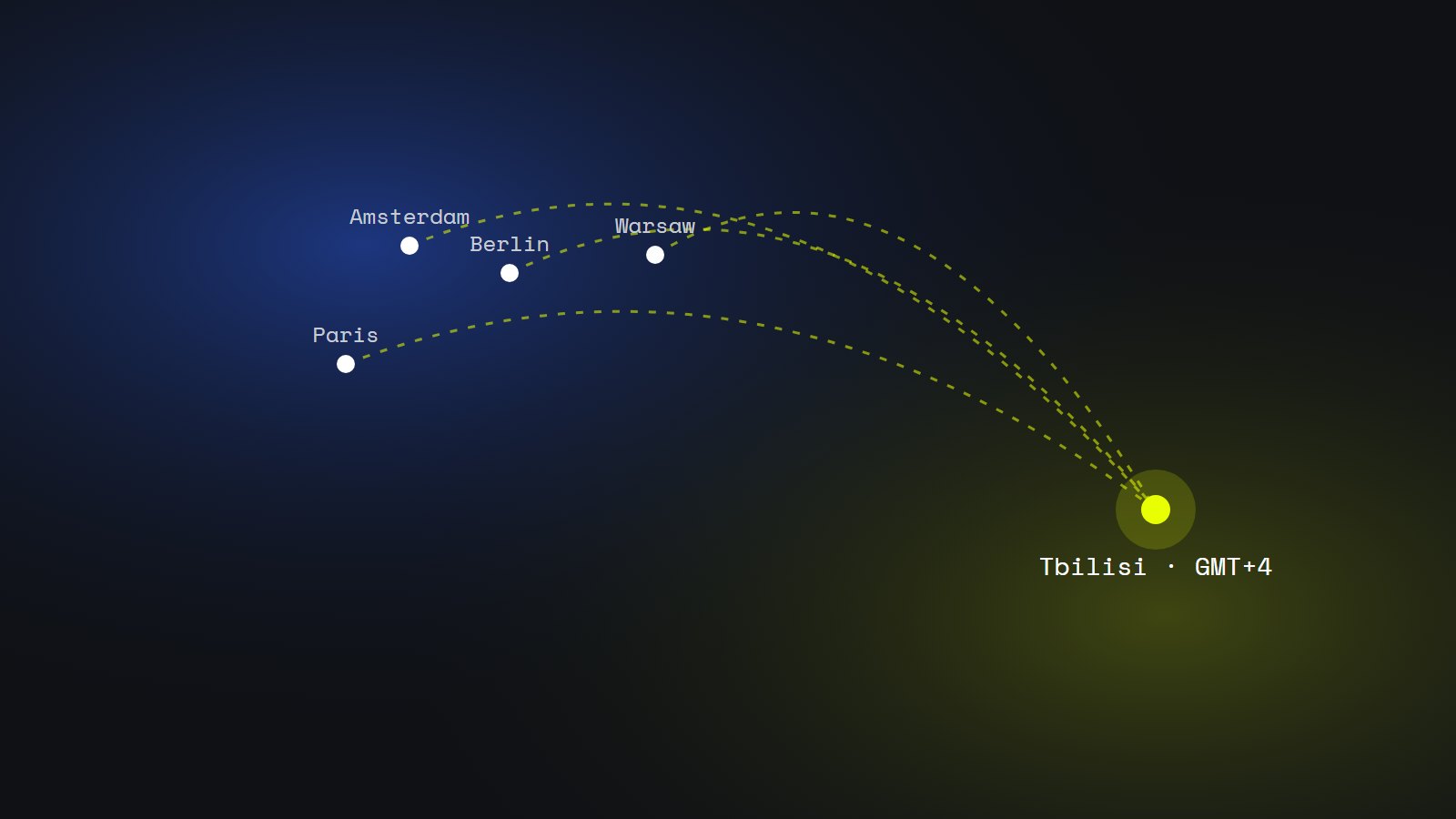
- Tbilisi is 2–3 hours ahead of Central Europe, so the whole European working day overlaps.
- Georgia has no EU adequacy decision: use a DPA with Standard Contractual Clauses and keep personal data in the EU where possible.
- The EU AI Act applies to systems used in the EU; plan risk classification, oversight and documentation early.
- Agree IP ownership, NDA and pricing in writing, check shipped work, and start with a small paid pilot.
Many European companies have an AI feature on their roadmap and nobody free to build it. Hiring machine learning engineers locally is slow and expensive, and teams on the other side of the world answer questions while you sleep. Georgia has become one of the options in between.
This guide covers what a European buyer should check before working with an AI team in Georgia — from time zones and data protection to contracts and the first project. We are a team in Tbilisi, so read it with that in mind; the checklist applies to any partner you consider.
Working hours and communication
Tbilisi uses GMT+4 all year round, which puts it two hours ahead of Central European Summer Time and three hours ahead in winter. In practice the whole Central European working day falls inside the Georgian one: a 10:00 stand-up in Berlin or Paris is early afternoon in Tbilisi, and there is still time to fix something before your evening.
English is the working language of most Georgian tech teams, and many engineers also speak Russian. Direct flights connect Tbilisi with a number of European cities, so an in-person kickoff workshop is realistic when it helps.
GDPR and data transfers
Georgia is outside the European Union and does not have an EU adequacy decision, so personal data cannot simply be sent there. The usual solution has two parts. First, a data processing agreement that includes the EU Standard Contractual Clauses. Second — and often more effective — an architecture in which personal data never needs to leave the EU at all: systems are hosted in an EU cloud region, and the team works with anonymised, pseudonymised or synthetic data wherever possible.
Ask any partner to explain which data they will access, from where, and under which agreement. A clear answer to that question in the first call is a good sign.
The EU AI Act
The EU AI Act applies to AI systems placed on the EU market or used in the EU, regardless of where they are built. Its obligations depend on the risk level of the use case and are being phased in over several years.
In practice this means your partner should help you classify the use case early, and for systems that need it, design human oversight, logging and transparency for users, and prepare the technical documentation from the start. Formal legal interpretation belongs with your own legal adviser; a good engineering partner makes their job easier by building the evidence as the product is built.
Contracts, intellectual property and payment
Agree in writing who owns the source code, the trained model weights and the data pipelines — the usual answer for custom work is that the client does. Sign a non-disclosure agreement before any confidential details are shared, and define how the work is priced: a fixed price per milestone for well-defined projects, or a monthly dedicated team when the scope will evolve.
Check which currency you will be invoiced in, how payments are tied to milestones, and what happens to the code and documentation if the engagement ends early.
How to evaluate a partner
Look for shipped work you can inspect, not only slides: products in production, case studies with real problems, and verified client reviews on independent platforms. Ask who exactly will work on your project and talk to them directly, because in a small team the people on the scoping call should be the people writing the code.
Ask how they measure success. A partner who agrees a concrete metric before building — accuracy on your data, time saved per task, a conversion change — and reports against it is easier to manage than one who promises “AI transformation”.
Start with a paid pilot
The lowest-risk way to begin is a small, paid, time-boxed pilot: one problem, one metric, a working prototype on your own data in a few weeks. It tests the team, the communication and the data together, and gives you something real to show internally before committing to a larger budget.
That is the way we prefer to start with European clients at MLMind: a free scoping call, a written plan with a success metric, then a prototype you can evaluate — with the data protection agreements in place before any data changes hands.