Case study · Healthcare · internal tools
An internal app where staff ask questions and get answers from the company’s own medical documentation
A medical company’s documentation had grown too large to search, and people spent too long hunting for the right answer. MLMind built one internal app for workers, accountants and managers, with an assistant that answers questions in plain language from the company’s own documents only.
- What we built
- Internal communication app with retrieval-augmented generation (RAG) search over company documents
- Industry
- Healthcare · internal tools
- Our role
- Client project, delivered end to end by MLMind (client under NDA)
Quick answers
- 01
Built: an internal app that connects workers, accountants and managers, with a natural-language search over the company’s medical documentation.
- 02
For: a medical company (name under NDA) whose documentation was large and hard to search.
- 03
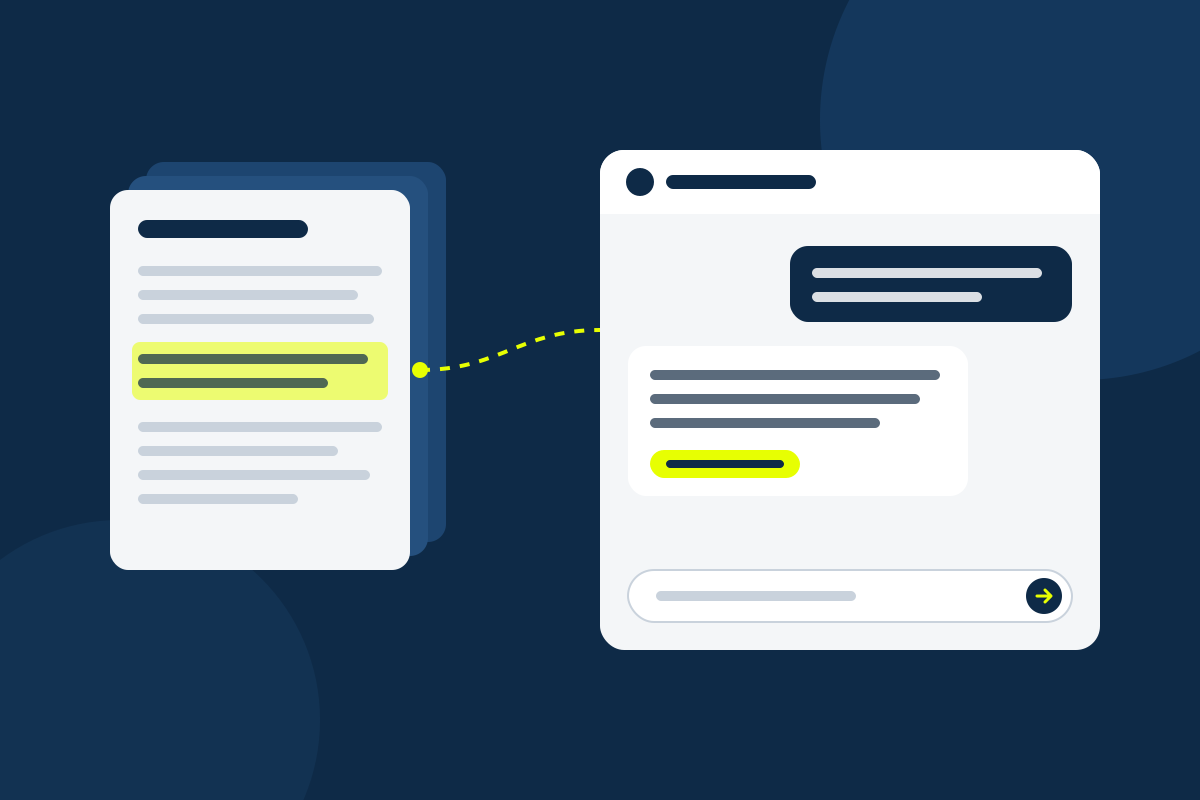
How it answers: retrieval-augmented generation. The assistant first finds the relevant passages in the company’s documents, then a LLaMA model writes the answer from those passages only.
- 04
Stack: Python and FastAPI on the back end, an open-weights LLaMA model, and a retrieval layer over the document base.
- 05
Scope: MLMind handled the whole project, from requirements to deployment.
Overview
The client works from a large body of medical documentation. Finding one answer in it meant knowing which document to open and reading until it turned up, so people across the company spent a large part of their time searching instead of working. Communication between workers, accountants and managers was spread across separate channels as well. MLMind built a single internal app for both problems: a shared place to communicate, and a search that understands questions asked in ordinary language. The search is built on retrieval-augmented generation, so every answer comes from the company’s own documents rather than from what a language model happens to know.
Challenges
Large, hard-to-search documentation
Keyword search fails when people do not know the exact term a document uses. The search had to understand the question, not just match words.
Answers must come from the documents
In a medical setting an invented answer is worse than none. The model was restricted to the company’s own material instead of its general knowledge.
Three very different groups of users
Workers, accountants and managers ask different questions and need different parts of the documentation, in one app they all use.
Communication in one place
Questions, answers and discussion had to live together, so a found answer could be shared with colleagues without leaving the app.
How it works
Requirements
Who asks what, which documents answer it, and what the app must do for each group of users.
Document pipeline
The documentation is split into passages and indexed, so the right passages can be found for any question.
RAG assistant
A LLaMA model, served behind a Python/FastAPI back end, answers each question from the retrieved passages only.
Deployment
The app was released to the company’s staff, and MLMind carried it through deployment.
What we delivered
Internal app
- One place for communication between workers, accountants and managers
- Questions and answers shared inside the app
AI search
- Questions in plain language over the company’s medical documentation
- Retrieval-augmented generation with a LLaMA model
- Answers drawn from the company’s own documents only
- Python/FastAPI back end
Stack
 Python
Questions
A way of using a language model so that it answers from your documents. The system first retrieves the passages relevant to the question, then the model writes an answer from those passages instead of from its general training.
LLaMA is an open-weights model, so it can be run on infrastructure the client chooses rather than sent to a third-party API. For medical documentation that control often matters.
Yes. Start with the RAG proof-of-concept on the services page: we test the approach on a sample of your documents before you commit to a full build.
Your project
Want something like this for your business?
Tell us what you are trying to do. An engineer replies within one business day with an honest first read, and the estimator gives you a budget range in three minutes.
- Reply within one business day
- Free 30-minute consultation — no obligation
- NDA before any details change hands
- Working prototype in 3–6 weeks
- You own the code and the models
- GDPR: DPA and EU data hosting
Get a free project estimate
Tell us what you need and an engineer — not a salesperson — replies within one business day.